


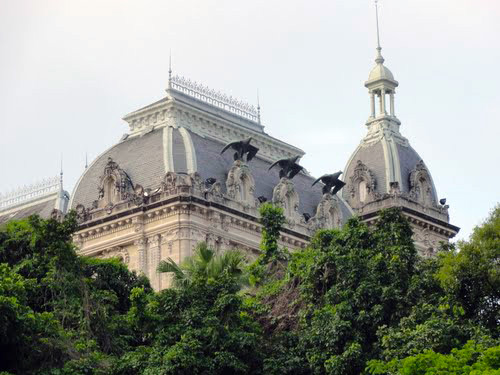
Altivo Pedras supplied the slate tiles used in the most recent renovation of the roof of the Palácio das Laranjeiras, the official residence of the governor of the state of Rio de Janeiro.
The palace administration opted for slate tiles from Altivo Pedras because of the excellent quality of the raw material and the finish of the product, as well as the on-time delivery.
About Palácio das Laranjeiras
Organized internally into three different floors, each with a well-aligned function,the Palácio das Laranjeiras lives up to the neighborhood of buildings designed by Lúcio Costa. “I still have memories of the time when the Palace was simply my grandfather’s house. It was a beautiful place and it seemed gigantic to me – at least that was the impression when my grandmother Branca (Ribeiro Guinle) and I stayed there. The exceptions were my mother, who always liked to receive her friends, such as the concert pianist Madalena Tagliaferro, who took the opportunity to give us great recitals,” says Ambassador Teresa Castello Branco, who spent her childhood at the Palace. Purchased by the federal government in 1947 to house distinguished visitors, it was due to Getúlio Vargas’ suicide in Catete that his successor, Juscelino Kubitschek, moved the official residence there – at least until the inauguration of Brasília in 1960.
More information:
The former residence of the Guinle family was built between 1909 and 1913. At that time, the entire park belonged to the family. After the death of Eduardo Guinle in 1941, negotiations began between the family and the Federal Government. In 1947, President Dutra concluded the negotiations by acquiring only the palace, which would be used to host distinguished visitors and heads of state visiting Brazil.
It was used as the official presidential residence by Juscelino Kubitschek (1956–1961), who chose not to stay at the Palácio do Catete after the suicide of Getúlio Vargas in 1954. Kubitschek occupied the residence until the Palácio da Alvorada was completed and inaugurated in Brasília in 1958.
With the inauguration of the new capital in 1960, the Laranjeiras Palace came under state administration and became the residence of the governor of the state of Guanabara. This continued until 1975, when the state was merged with the state of Rio de Janeiro.
Since then, the palace has served as the residence of the President of the Republic during official visits to Rio de Janeiro and has also been used for diplomatic receptions. Over time, several governors of Rio chose instead to reside in Gávea Pequena. Among the palace’s distinguished visitors were former presidents Charles de Gaulle of France and Harry Truman of the United States.
The palace’s collection includes paintings by Frans Post, a replica of the piano that belonged to Queen Marie Antoinette of France, marble and ceramic mosaics with 24k gold applications, as well as sculptures and furniture.
It was opened to the public in 2001 after a ten-month renovation. During this period, historians, museologists, researchers and restorers recovered and cleaned paintings, floors and furniture. The restoration was carried out thanks to an agreement between the State Government, the Federation of Industries of Rio de Janeiro (Firjan) and Petrobras, with a total investment of R$1 million. After the intervention, the state government opened the palace to visitors, who were guided by history students from the Rio de Janeiro State University (UERJ).
Since 2007, the building has once again been closed to the public. It is listed by the National Historical and Artistic Heritage Institute (IPHAN).
Today, the Laranjeiras Palace is the current seat of government for the state of Rio de Janeiro. It is located in the Laranjeiras neighborhood in the capital city and is sometimes incorrectly called Palácio das Laranjeiras.
Curiosity
A common curiosity about the name is that the improper use of the contraction in “Palácio das Laranjeiras” is due to the belief that the neighborhood was named after the palace, which is common in other regions. In reality, the opposite is true: the building was erected when the neighborhood had already existed under this name for more than 200 years. Moreover, there are no orange trees on the property. Although the government of the state of Rio de Janeiro uses the correct name, Palácio Laranjeiras, the palace’s own website states that “President Geisel donated the Palácio das Laranjeiras to the new state.”
Address and phone numbers
Rua Pinheiro Machado, S/N – Laranjeiras – Rio de Janeiro – RJ
Next to Fluminense’s headquarters. Building attached to the Guanabara Palace, inside the Guanabara Palace.
(21) 2334-4054 / 2334-3229 / 2334-3169
Laranjeiras Palace dining room
Source
Wikipedia: http://pt.wikipedia.org/wiki/Pal%C3%A1cio_Laranjeiras